If you’re a job seeker, AI interviews probably feel like the strange fever dream no one warned you about.
And if you’re a hiring manager, you may already be crying into your keyboard, wondering how 600 resumes all managed to sound like they're generated by the same three ChatGPT prompts.
We’re all a little distraught, understandably.
Before we dive into the highs, lows, wins, fails, delights, and absolute horrors of being interviewed by a faceless platform, let’s ground ourselves in what the data actually says.
What the Numbers Show: AI Is Settled Into the Hiring Process
This isn't experimental anymore. We all know that AI is doing initial screens of candidates.
Some quick reality checks:
- HireVue states that 73% of HR pros now trust AI to make candidate recommendations.
- Roughly 50% of job seekers think AI could actually improve hiring and reduce bias.
From Truffle’s roundup,“100 AI Recruitment Statistics You Need to Know Before 2026,” we get more receipts:
- 43% of organizations used AI for HR tasks in 2025 (up from 26% the year before).
- 99% of hiring managers use AI somewhere in their process, and 98% say it’s making things more efficient.
- Companies using AI-assisted messaging are 9% more likely to make a quality hire (translation: yes, an LLM can actually write better outreach than Todd in Recruiting).
- 65% of recruiters now use AI to save time or money (usually both).
- 43% report better quality of hire.
- 35% say time-to-hire drops by up to 50%.
- And 66% say they’ve cut hiring costs using AI tools.
The TL;DR of all this?
Hiring managers: AI will be screening your candidates. Possibly before you even know the role was opened.
Candidates: AI interviews aren’t a trend; they’re the new “business casual.” A little uncomfortable now, but soon you’ll forget a world where they didn’t exist.
Either way, we’ve all hit the point where the only question left is: How do we use these tools, particularly Automated Video Interviews (AVIs), wisely instead of letting them set everything on fire?
Why Companies Are Using AVIs (and Why They Feel Inevitable)
“Companies are heading into a hiring crisis created by AI, and most don’t realize it,” says Mike Wolford, CEO of Lex Duo and Author of The AI Recruiter and The AI Analyst.
And he isn’t being dramatic. He’s being accurate.
AI makes it easier to apply to everything → hiring teams drown in applications.
Candidates can feed any interview question into GPT mid-call → beautifully polished answers everywhere.
Which means:
- Traditional skill validation? Broken.
- Phone screens? Now cosplay.
- Consistent review? Lol.
Wolford calls it a “prisoner’s dilemma.” If every company uses the same AI tools in the same way, nobody gains an edge, and everybody gets buried in an avalanche of identical resumes and indistinguishable interview responses.
Companies leaning too hard on AI become less efficient, not more. Candidates leaning too hard on AI become indistinguishable from each other.
Everyone loses.
Here’s where Forbes comes in with a reality check. Automated Video Interviews (also known as on-demand or asynchronous interviews) are deceptively simple.
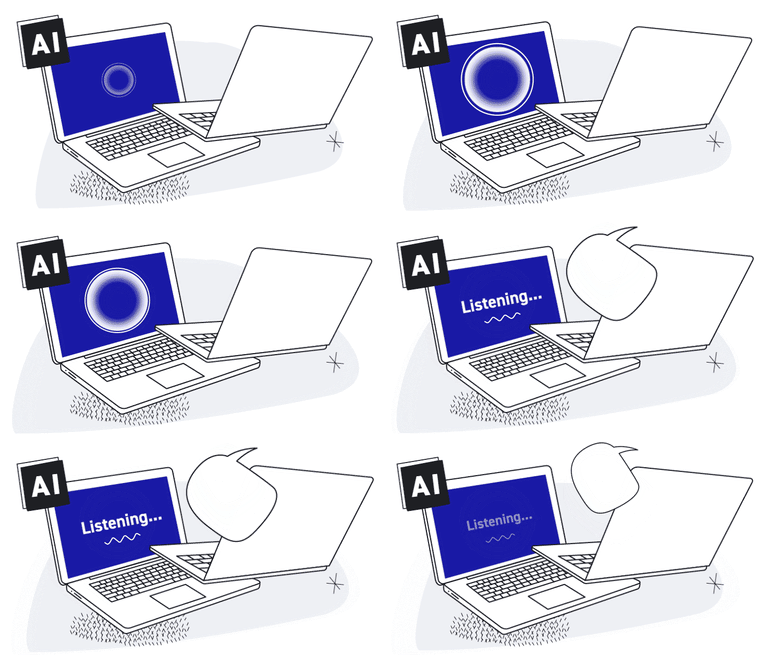
Companies invite candidates to a platform (think SparkHire, myInterview, HireVue). Written questions pop up on the screen, candidates record their answers, and AI analyzes everything: facial expressions, voice tone, keywords, confidence, vibes… and possibly how long you held eye contact with your webcam.
The system spits out a transcript and a performance summary for a recruiter who’s deciding if you move forward. No small talk, no handshakes, no nervous laughter. Just your answers, your face, and an algorithm contemplating them.
From the company’s standpoint? It brings order to chaos.
From the candidate’s standpoint? It’s basically karaoke with consequences.
(Both completely fair, tbh.)
Despite the frustrations, the companies that learn to adapt (and the creative candidates who learn to navigate this new terrain) are the ones who will shape the future of work.
The rest? Stuck wondering why their interview process feels like a bad Black Mirror episode.
How Creative Teams Are Implementing AI Interviews (And Where It's Working)
There’s genuine reason for optimism, and it’s backed by real data, not hype. As highlighted by Jonathan Albarran, real-world implementations show that when used thoughtfully, AI interviewing can deliver significant, measurable gains for employers.
Albarran highlights real-world wins:
- Hilton reduced hiring time for high-volume roles from six weeks to just five days by integrating AI chatbots into its process.
- Unilever cut its recruitment time by 75% using platforms like Pymetrics and HireVue.
- General Motors saved roughly $2 million a year in recruiter time through Paradox’s Olivia.
- 7-Eleven reports saving 40,000 hours per week on interview scheduling alone.
- Children’s Hospital of Philadelphia freed 6,700 recruiter hours and saved $667,000 annually by adopting AI-driven screening tools.
He also points out that the adoption curve is steep:
- 82% use AI to screen resumes.
- 64% use it to grade assessments.
- 58% use it for video interview analysis.
- 24% already have AI conduct entire interviews.
And the upside gets even better for both job seekers and hiring managers. According to the World Economic Forum, structured AI interviews don't just speed things up; they actually improve fairness and quality. By keeping questions consistent, it removes a lot of human unpredictability. A Stanford study even found that candidates who passed AI screening crushed their next human interview: 53% success compared to 32% from old-school resume review. Companies are also seeing real gains, like 25% higher retention and up to 40% better hiring accuracy.
“Specifically, AI interviews showed significantly higher conversational quality and more relevant, well-structured questions than their human counterparts,” explains the source. “Importantly, AI interviews exhibit a lower standard deviation in quality scores, ensuring higher consistency compared to human-led interviews, which in turn creates a fairer process for all candidates.”
The real superpower here is scale. AI can run thousands of interviews simultaneously, 24/7, without ever getting tired. For hiring teams drowning in applications, that kind of capacity turns “impossible to screen” into “totally manageable.”
These successes demonstrate the real potential of AI interviews, but they also set the stage for the risks and challenges many companies still underestimate, and candidates are experiencing them in real-time.
What This Really Feels Like for Creative Candidates
Realistically, anytime you bolt new tech onto an old hiring process, it’s going to creak, groan, and occasionally burst into flames. There will be pain points.
Creative folks feel this the most. Graphic designers, copywriters, art directors — half of them are sitting in front of a webcam, wondering, “How exactly am I supposed to prove my value when no one is even here? ”
A Mindset Shift That Helps
But let’s start with reframing this process and understanding how you can win, too. Instead of imagining the system as a soulless judge, think of it as a mildly bored bouncer with a clipboard.
It’s not your new boss. It’s not your creative soulmate. Its job is simply to confirm that you belong in the next round.
Check the boxes, stay calm, and trust that the real humans (the ones who can actually appreciate your brilliance) are waiting on the other side.
What an Automated Interview Actually Feels Like
You put on a professional top (pajama bottoms still on, obviously), find the perfect background, and prepare to talk to… a static image.
A Telegraph journalist documented her AVI experience:
- The candidate logs in for what looks like a normal senior writer interview.
- They’re greeted by a still photo of “Alex,” the AI software's chosen avatar.
- No warm-up, no small talk. Alex jumps straight into structured questions.
- The system walks through questions about tailoring content, error-proofing, and editorial strategy.
- The exchange feels weirdly natural (answers followed by AI affirmations) but still unmistakably robotic.
Essentially, it’s the illusion of interaction in that there’s just enough back-and-forth to mimic conversation, but without any of the humanity. No rapport, no shared humor, no subtle cues. Just efficiency in its purest, most sterile form.
Unsettling? Definitely.
But it’s important to recognize that this is the new reality: early-stage interviews where the “person” on the other side of the screen may not be a person at all. It’s understandable to feel uneasy about this shift.
How Candidates Are Reacting (Spoiler: It’s Complicated)
The data reflects tension, not rejection:
- 38% of candidates say they’d reject a company that relies heavily on AI in hiring.
- 60% want at least some human interaction during the process.
- 46% of job seekers say their trust in hiring has dropped, and 42% blame AI.
At the same time:
- 53% of new hires now use generative AI tools in their job search, suggesting that many candidates are adapting even if they don’t love the shift.
In short: we’re all getting used to AI interviews… but not gracefully.
How to Approach the AI Interview (Without Losing Your Personality)
Robert Hays, Consultant and Owner at HelpWizards, shares first-hand experience, offering some sound and optimistic advice for others in the process.
His main insight? Success comes down to understanding what the system is actually listening for.
What AI “listens” for:
- Clear, structured, data-rich statements.
- Specific tools, metrics, and accomplishments.
- Continuous speech (since long pauses can be misread as non-answers).
- Signs of engagement (even asking questions at the end helps, even if the system can’t respond in real time).
“This new interview format feels strange, but it’s workable — and those who embrace it will come out ahead,” Hays shares.
And he’s right: Opting out isn’t much of a strategy. It’s self-elimination.
Quick Tips for Acing an Automated Video Interview
Jane Hanson, Contributor for Forbes, offers these practical pointers:
Prep Like a Pro:
- Practice talking to a camera until it stops feeling like a hostage video. Tools like Standout.com can help.
- Use specific language. Pull keywords from the job description and industry terminology.
- Prepare strong, repeatable answers to common prompts.
Optimize Your Setup:
- Remember to find good lighting, a quiet room, and use a simple background.
- Avoid sitting with backlighting (AI vision hates that).
- Look directly into the camera, not at your reflection.
Deliver with Confidence:
- If re-recording is allowed, use it strategically to watch, adjust, and retake.
- Boost your enthusiasm slightly; cameras tend to flatten energy.
- Afterward, email a real human to thank them and ask about next steps.
AI video interviews are quickly becoming the standard first step. Your best strategy is to prepare well, embrace the weirdness, and get comfortable showing your authentic self, even when the “person” you’re talking to doesn’t technically exist.
And on the hiring manager’s side, there are several key elements to watch for and refine, challenges to iterate, and aspects to never just leave in the hands of AI.
AVIs Aren’t Perfect. Here’s How Hiring Managers Can Make Them Better
While it may feel like these big-bad-AI wolves are out to crush your confidence, take heart. Many companies are feeling these pain points as well and are trying to do things right, listen to feedback, and trying to improve the candidate experience.
Point in case: To better understand how candidates actually experience AI-driven interviews, WerkLabs spoke directly with members of The Mom Project Talent Community, then validated those findings through a broader quantitative study.
The recommendations below reflect what candidates say they need most — along with practical actions hiring teams can take to make AI video interviews more supportive, equitable, and effective.
Concern: Candidates often describe AVIs as cold and disconnected (no rapport, no human cues, no sense of conversation).
Improve this by:
- Having the hiring manager record themselves asking the questions.
- Including a light or personal opener to break the ice.
- Acknowledging the awkwardness, saying something like, “We know this format can feel unfamiliar. There’s no ‘perfect’ response here; we’re simply interested in understanding your experience.”
Concern: Applicants often feel unsure about what makes a “good” AVI response or how the technology works.
Improve this by:
- Providing examples of strong responses or clear guidelines.
- Ensuring the instructions and platform setup are simple, reliable, and easy to follow.
Concern: Strict countdowns and one-shot recordings heighten anxiety and reduce authenticity.
Improve this by:
- Offering more flexible time limits and the option to rerecord.
- Allowing candidates to save multiple takes and choose which to submit.
- Giving interviewees the choice to hide or display the countdown clock.
Concern: Without a human present, candidates can’t ask clarifying questions or confirm they’ve fully addressed the prompt.
Improve this by:
- Writing prompts that are clear, specific, and easy to understand.
- Allowing applicants to submit their own questions at the end of the interview.
Concern: Candidates want to know what happens to their recordings — who sees them, how long they’re stored, and how their data is used.
Improve this by:
- Explaining your recording and data retention policies upfront.
- Being transparent about who reviews the videos and how the information is protected.
One final note, or “concern”: even if the interview was asynchronous and you weren’t “in the room,” candidates still invested genuine time, effort, and emotional energy. Honor that. Follow up. Acknowledge the work they put in. Offer feedback when allowed. For the love of basic professional decency, show them their effort didn’t disappear into an AI void.
Where We Go From Here
The future of hiring is already here. It’s a little weird, a lot new, and undeniably evolving.
Creative candidates: don’t write off an AVI just because it feels unfamiliar or because you worry your spark won’t translate. Forward-thinking creative leaders are adapting too, finding new ways to read nuance, evaluate talent, and protect the human elements of creative work.
Hiring managers: as you adopt more efficient tools, lead with empathy, clarity, and transparency. Technology may automate steps, but it’s your humanity that elevates the experience.
Whether you’re hiring or navigating AI-assisted interviews for the first time, Artisan Talent is here to help you move forward with clarity and confidence.
We partner with hiring teams to design candidate experiences that balance efficiency with real human judgment, and we help creative professionals show their strengths, no matter the format, including AVIs.
Because technology can streamline the process. People still make the decisions.