Specialist vs generalist. It's one of the most contentious debates in the creative space. Ask a room of creative directors, and you'll get a full spectrum: the ones who want a unicorn hire who does everything, and the ones who've been burned by that approach and now only want deep specialists.
But we’re here to officially stan the specialized generalist.
That’s right. The professionals who are actually moving creative teams forward right now are neither pure specialists nor generalists. They're T-shaped. And if you're a hiring manager who hasn't made that mental shift yet, the gap on your team is probably already showing.
Because, as Benjamin Hiorns so aptly explains, in the creative industries, where hiring managers so often swing between chasing “unicorn” hires and demanding hyper-niche mastery, T-shaped creative/tech hybrids offer something far more practical. They offer depth where it matters, range where it counts, and the ability to connect ideas, people, and processes to move creative work forward.
Our position is simple. When the creative team is also expected to be the tech team, the strategy team, and the AI team, the hires who thrive combine deep craft expertise with the versatility to guide strategy, shape systems, and unlock momentum across teams. T-shaped creative/tech hybrids aren't a nice-to-have anymore. They're the hire that makes every other hire work better.
The Specialized Generalist Is Already Outperforming Everyone Else
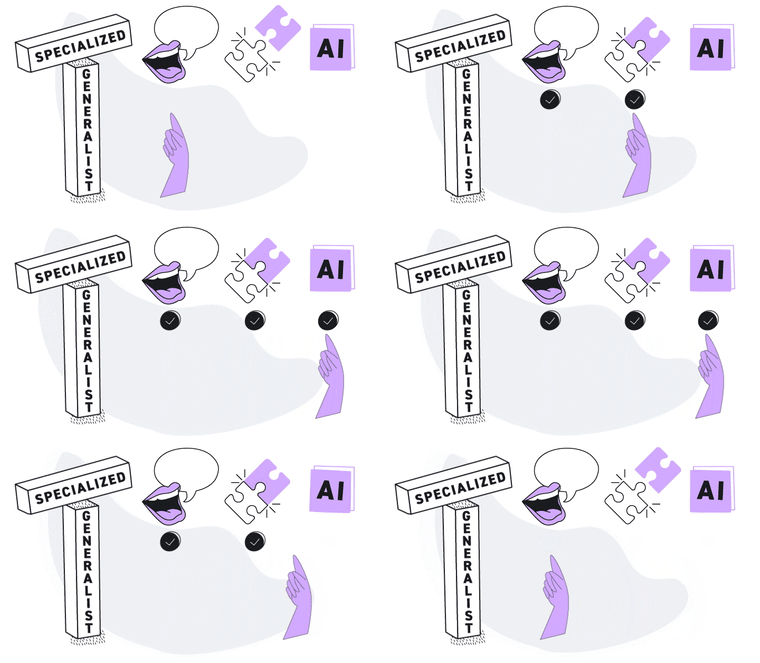
T-shaped creatives combine deep expertise in one area (the vertical of the “T”) with working knowledge across multiple disciplines (the horizontal). That balance has practical implications for how teams operate.
Jason Yip, Senior Agile Coach at Spotify, puts it plainly, “Since every task in our workday doesn’t require an expert, non-expert tasks can be offloaded to T-shaped team members. Because their skills and experience aren’t limited to a single niche, they can contribute to various projects across the org.”
This kind of cross-functional flexibility encourages cross-training. And when creative production intersects with automation, data, design, and engineering, and these hybrid thinkers are often the ones who can connect ideas across functions and develop new workflows.
But even before AI hit mainstream workflows, the Wall Street Journal called out the emerging performance of a generalist-specialist hybrid, stating that the future of work favors specialists who also have cross-functional awareness and strong soft skills and that these hybrid workers help organizations stay efficient, innovative, and collaborative in a rapidly changing environment.
A growing body of workforce research reinforces this shift. In a recent McKinsey Global Survey, 87% of leaders acknowledged skill gaps in their organizations, yet fewer than half reported having a clear plan to address them. As technology continues to reshape how teams collaborate and produce work, the need to upskill employees and rethink traditional role definitions is only becoming more urgent.
The Best Hires Have Range AND Depth
We'll say it again: people with diverse experience in their discipline add the most value. A Product Designer with an engineering background simplifies the handoff between design and development, helping the product ship faster. A UX designer with an illustration background can offer valuable insight into things like building an icon library or estimating production timelines. While these creatives' main focus stays in their team, their past experience adds a practical perspective. This kind of contribution supports better collaboration and hiring decisions, without blurring boundaries or replacing specialized roles.
Harder to quantify, there's also a human advantage to this type of hire. Specialized generalists tend to be strong listeners, open to feedback, and motivated to improve the creative process, not just the output. They understand their strengths, but just as importantly, they know when to rely on the expertise of others. By leading with empathy and curiosity, they can help diffuse tension, align teams, and refocus energy on what matters most: doing thoughtful work together and moving projects forward.
Creative Engineers Are the T-Shaped Profile in Action
Understanding the value of the specialized generalist at a high level is one thing. Seeing how this capability shows up in real creative work is another.
Creative/tech hybrids (aka Creative Engineers) are one of the clearest examples of this profile in action today. Increasingly, these roles are evolving beyond simple cross-functional awareness. As AI reshapes creative production, the real differentiator is no longer just how much knowledge someone has — but how effectively they apply judgment, interpret nuance, and guide decision-making in complex environments.
Even the internet sees why versatility is invaluable in UX Design.
“This hybrid skill set enables T-shaped UX Designers to collaborate effectively across teams and disciplines,” Product Designer, Smithin MS elaborates. “It allows them to adapt to various challenges and provides well-rounded insights throughout the design process.”
That capability shows up in many creative/tech roles:
- Product Designer with front-end fluency. This person understands front-end development well enough to anticipate technical constraints before handing anything off. Instead of handing off static mockups, they collaborate with engineers on interaction logic, performance trade-offs, and implementation timelines. This often leads to fewer revisions, faster iteration cycles, and smoother product launches.
- Creative Technologist bridging marketing and data. A Creative Technologist working on campaign experiences might combine storytelling skills with working knowledge of analytics tools or marketing automation platforms. That combination produces creative concepts that are not only compelling but measurable and scalable based on real user behavior.
- Motion designer with systems thinking. A motion designer who understands design systems and brand governance can help establish animation guidelines that scale across platforms. Rather than creating one-off assets, they contribute to reusable frameworks that keep experiences consistent while saving production time.
AI Didn't Create the T-Shaped Professional. It Made Them Non-Negotiable.
AI has stepped in as the one in the room you can turn to with any question. But knowing something and knowing what to do with it are completely different skills.
Rui Nunes summarizes it well, "[AI] is like having every instruction manual ever written available at your fingertips. But following a recipe book and being a chef are two entirely different things. One produces edible food. The other creates experiences that change how people think about dining.
What this means in practice:
- Choosing between a specialist or a generalist is less relevant in the age of AI.
- The advantage now belongs to specialists who are also fluent in using AI to extend their impact.
- Competing with AI on broad, surface-level knowledge alone is increasingly unsustainable.
- While AI-savvy generalists offer value, deep, experience-based expertise creates long-term differentiation.
- AI helps build breadth across functions, but human insight is essential for complex judgment and nuanced problem-solving.
- The emerging skill set for the future of work is therefore a modern form of T-shaped capability: depth in a craft, supported by AI-enabled range.
3 Hybrid Roles Solving Real Problems on Creative Teams Right Now
Now, let's get specific. What type of jobs are well-suited for this T-shaped structure and impact? What do these hires look like and how do you know if you should hire one?
Design Engineer
What this role actually does: Design Engineers bring deep front-end engineering expertise paired with strong UX and product sensibility. They translate design intent into polished, performant user experiences. They think across platforms, build scalable component systems, and collaborate fluently with designers, product managers, and backend engineers. They own features from prototype through ship.
What this job improves within a creative team:
- Closes the gap between design vision and technical execution, resulting in higher-quality shipped work.
- Improves product velocity by enabling faster iteration and reducing handoff friction.
- Helps establish consistent interaction patterns and scalable UI systems.
- Elevates the overall craft of digital experiences through attention to performance and detail.
- Encourages tighter collaboration between creative and engineering functions.
You probably need a Design Engineer if:
- Your team struggles to maintain design quality at launch. If visual polish, motion, or usability degrade during development, a design engineer can help protect the integrity of the experience.
- Frontend work is slowing product innovation. When teams spend excessive time translating specs or rebuilding similar components across platforms, this role can streamline execution.
- Design and engineering operate in silos. If collaboration requires constant mediation or leads to rework, a hybrid builder can improve alignment and shared ownership.
- You’re scaling digital products and need stronger systems thinking. Growing teams often need someone who can balance creative craft with technical structure to support sustainable growth.
UX/Product Designer
What this role actually does: UX/Product Designers combine deep UX craft with product design execution, systems thinking, research fluency, and the ability to influence stakeholders across functions. They're not just designing screens. They're connecting long-term strategy to hands-on delivery across multiple products and building the design systems that support sustainable team growth.
What this job improves within a creative team:
- Aligns design, product, and engineering to move ideas from concept to execution faster.
- Grounds creative decisions in real user insight and measurable product outcomes.
- Bridges long-term strategy with hands-on design delivery across multiple products.
- Builds scalable systems that improve consistency, efficiency, and team velocity.
Facilitates collaboration and surfaces opportunities that strengthen overall product direction.
How to tell if you need to hire a UX/Product Designer:
- Projects stall between teams. If design, product, and engineering regularly misalign or lose momentum during handoffs, you likely need someone who can translate across disciplines and keep work moving.
- Strategy and execution feel disconnected. When strong ideas struggle to make it into shipped experiences — or tactical work lacks a clear product vision — a hybrid thinker can help bridge that gap.
- You’re scaling products, but processes aren’t scaling with you. Inconsistent UX patterns, duplicated effort, or fragmented design systems are signs you need someone who can build structure while still delivering craft.
- Decisions are driven more by opinion than insight. If your team lacks the ability to connect research, analytics, and business goals into a clear creative direction, a T-shaped role can improve confidence and clarity.
- Innovation feels slow or siloed. When experimentation stalls or new ideas struggle to gain traction across functions, a cross-functional creative can help unlock momentum and alignment.
AI Content Engineer
What this role actually does: AI Content Engineers bring a strong foundation in content strategy, writing, or editorial craft, paired with technical fluency in AI tools and content systems. They design, test, and optimize prompts, workflows, and automated content pipelines. They understand brand voice and audience experience across channels, and they use data to evaluate and refine outputs. Critically, they bring systems thinking to content production: templates, automation, governance, and scale.
What this job improves within a creative team:
- Increases content velocity without sacrificing quality or brand consistency.
- Helps teams integrate AI into creative workflows in a thoughtful, strategic way.
- Translates business goals and audience needs into scalable content systems.
- Reduces manual production bottlenecks through smarter processes and tooling.
- Enables experimentation with new formats, personalization strategies, and distribution models.
How to tell if you need to hire an AI Content Engineer:
- Your team is producing more content than ever, but is struggling to maintain quality. If AI outputs feel inconsistent or off-brand, this role can help implement structure and oversight.
- You want to scale personalization or omnichannel messaging. When content needs vary across audiences and platforms, a hybrid strategist can design repeatable systems.
- Creative teams are unsure how to operationalize AI tools. If experimentation is fragmented or driven by individuals rather than process, this role can create alignment.
- Manual workflows are slowing campaign or product momentum. An AI content engineer can streamline production while protecting narrative clarity and user experience.
Think of these roles as early signals. The rise of the creative-tech hybrid is only accelerating, and if this trend continues, the future of work may look less like a single T-shape and more like a full alphabet of emerging skill profiles.
The Teams Hiring Creative Engineers Now Will Have the Advantage Later
Lisa Bodell, makes the case clearly: makes the organizational case clearly: investing in T-shaped skills strengthens collaboration and communication at every level of a team.
"I believe we're now on the cusp of a hybrid model where the most valuable employees are interdisciplinary. While generalists know a little about a lot of subjects and I-shaped employees are experts in a single area, a T-shaped person is a subject-matter expert in at least one area and knowledgeable or skilled in several others. You'll open up silos and increase the agility of employees, which improves an org's overall efficiency."
The hiring question is no longer whether to prioritize depth or range. It is how to find the professionals who have both, and how to build teams where that kind of capability compounds.
These roles are early indicators of a broader shift. As AI continues to reshape creative production, the professionals who thrive will not be those who know the most. They will be the ones who know where to apply judgment, how to connect disciplines, and how to turn complexity into momentum.
That is the T-shaped profile. Finding people who genuinely carry both sides of that T is harder than it sounds, but it's exactly what we look for at Artisan. If you're ready to build around it, we may already know your next hire.

/Creative%20State%20of%20the%20Union%202019.jpg?width=436&height=255&name=Creative%20State%20of%20the%20Union%202019.jpg)