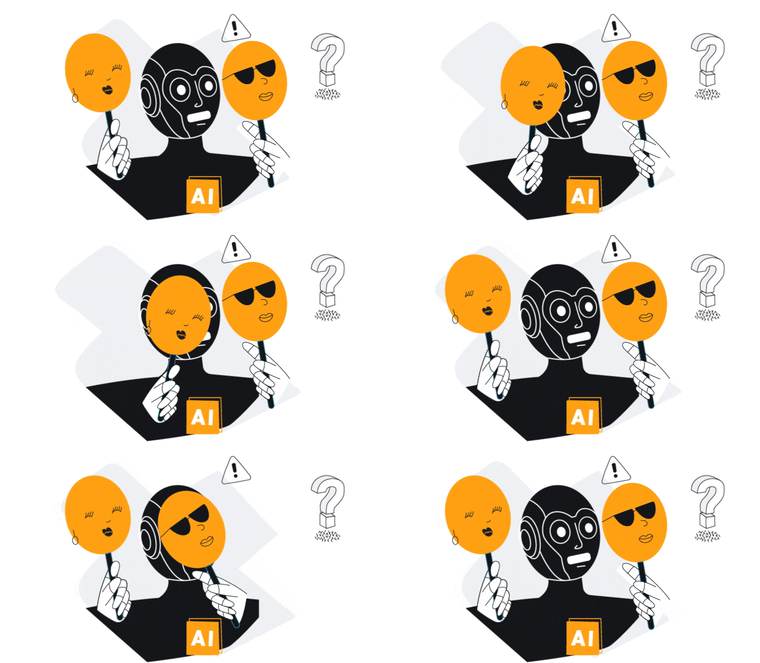
Knowing what's fake used to come with some obvious tells. Grammatical mistakes. A story that just doesn't add up. Strangers asking you to wire money.
We've all gotten better at clocking the scam toll texts and the "your insurance is about to lapse" calls, and yet, the fakes keep getting harder to spot.
Hiring is no exception, and the scams aren't new. We've talked about the hiring scams that job seekers encounter, but it's time to acknowledge that scams impact both sides in a frustrating new trend: candidate fraud.
Padded resumes, borrowed references, and embellished titles have all been part of the hiring landscape for as long as there's been a hiring landscape.
What's changed is the scale, the sophistication, and the cost. Reported losses from job-related fraud jumped from $90 to $501 million from 2020 to 2024. That’s a 457% increase in four years. And Gartner forecasts that one in four applicant profiles will be fraudulent by 2028.
So no, this isn't the same problem it was five years ago. And if your hiring process hasn't changed since then, you're bringing a checklist to a gunfight.
AI Made Candidate Fraud Cheap, Fast, and Scalable
Here's what AI has actually done to candidate fraud: it made it cheap, fast, and scalable.
Generative AI can now produce a resume tailored to a specific job description — complete with plausible metrics, role-appropriate vocabulary, and formatting that sails through ATS screening without a flag. A genuinely underqualified candidate can present as a near-perfect match before anyone's looked them in the eye.
There's also the problem of sameness. Terry Terhark, CEO at NXTThing RPO and a 30-year veteran of the recruiting industry, put it bluntly in a recent episode of the We're Only Human podcast. One of his recruiters recently pulled two resumes that were completely identical, with the same content and structure, with just a different name at the top.
When everyone's running their resume through the same AI tool against the same job description, the output starts to look the same. The resume that looks perfect is increasingly a red flag, not a green light.
As Forbes Council member Casey Marquette writes, basic resume parsers reward structure and keyword density without evaluating substance, and when hiring tools are designed for speed and efficiency rather than verifying authenticity, fraudsters learn the scoring patterns and exploit the gaps.
According to Checkr's 2025 Hiring Hoax Manager Survey:
- 59% of managers say they've suspected a candidate of using AI tools to misrepresent themselves during hiring.
- 62% agree that job seekers are now better at faking their identities with AI than hiring teams are at detecting them.
- 35% say someone other than the listed applicant has participated in a virtual interview.
- 60% have uncovered a candidate who misrepresented their experience or qualifications, and another 13% suspected it but couldn't prove it.
That last stat is worth sitting with. Nearly three-quarters of hiring managers have dealt with a candidate who wasn't who they said they were — or had good reason to think so.
The Four Types of Candidate Fraud in 2026
Fraud covers a wider range of behavior than it used to:
1. AI-enhanced credentialing is the most visible form.
This includes AI-generated resumes, LinkedIn profiles rebuilt to mirror job descriptions, and in some cases, simulated work samples and references.
According to Marquette, coordinated criminal groups go further: coaching operators to assume false identities, providing fake diplomas, interview scripts, and deepfake videos for impersonation.
Some use voice modulation and remote desktop access to deliver off-camera answers during live interviews. Once hired, these operators attend meetings, submit work, and quietly gather data or introduce system vulnerabilities.
2. Assessment outsourcing
Apps now exist to give candidates real-time talking points mid-interview — an earpiece feeding answers while the candidate nods along on camera.
During written assessments, a shared screen means someone else is doing the work entirely. The candidate who sounds impressive in the interview and can't find the file button on day one? This is frequently why.
3. Identity synthesis
This is the more sophisticated end of candidate fraud, blending real and fabricated data to pass automated background checks.
A fraudulent worker placed in a role with access to client systems isn't just a performance problem; it's a cybersecurity liability. In healthcare, finance, and legal, a fraudulent credential placed in a compliance-sensitive role can expose the company — and any agency that placed them — to regulatory penalties and civil liability.
4. Employment and identity misrepresentation
Sometimes that looks like a candidate secretly working two full-time jobs without disclosing it to either employer. Other times, it involves misrepresenting where a candidate is located, their work authorization status, or even aspects of their identity.
Terhark shared a case from his own firm: two technology professionals were hired for separate U.S.-based remote roles that required candidates to be located in the United States. It wasn't discovered until onboarding that both individuals were actually in India.
The surprising part? This happened twice, on two separate positions, despite a robust vetting process already being in place.
The example highlights a growing challenge for employers: candidate fraud is no longer limited to inflated resumes or embellished credentials. Increasingly, it's about verifying that applicants are who they claim to be and meet the requirements they present during the hiring process.
Candidate Fraud Is a Recurring Cost, Not a One-Time Loss
If fraud feels like an edge case, the numbers say otherwise.
23% of managers estimate their company lost over $50,000 to hiring fraud in the past year. Another 10% report losses exceeding $100,000. And those figures don't account for lost productivity, delayed projects, or the cost of starting the search over, which is considerable.
We've covered what a bad hire actually costs and what happens when a role stays open too long. Neither is cheap. Layer fraud on top, and you're compounding a problem that was already expensive.
Marquette points out that victims range from large enterprises to small firms, and that the downstream consequences include wage losses, data breaches, reputational damage, and compromised team performance. Half of all managers surveyed by Checkr said they've seen fraudulent hires cost their company time, money, or productivity on multiple occasions. Seventy percent believe hiring fraud is an underestimated financial risk that deserves more attention from leadership.
The pattern is clear: this isn't an isolated incident. It's a recurring, under-budgeted cost that most organizations haven't formally accounted for.
Traditional Hiring Processes Weren't Built to Catch Fraud
The challenge isn't that hiring teams aren't trying to catch fraud. It's that most hiring processes weren't designed for the kind of deception employers are facing today.
-
Background checks only verify what's presented.
Most screening tools are built to confirm information, not question whether it's authentic in the first place. And because those checks often happen near the end of the hiring process, after interviews, assessments, and reference calls, issues may not surface until significant time has already been invested.
-
The hiring process is fragmented.
A candidate may move through six or more systems before their first day, including an ATS, video interview platform, assessment tool, background screening provider, offer management system, onboarding software, and HRIS. Each system performs a specific function, but none were designed to work together to identify fraud patterns. Every handoff creates another opportunity for something to slip through.
-
Volume makes detection harder.
A surge in applications can look like a healthy talent pipeline, but it also creates more noise.
The larger the applicant pool, the harder it becomes to spot inconsistencies, investigate red flags, and separate genuine candidates from convincing impostors.
-
Work samples and portfolios aren't immune.
According to Terhark, candidates are now falsifying GitHub profiles, portfolios, and other work products in addition to resumes. Warning signs can include polished case studies with no documented process, work that lacks a clear connection to a candidate's career history, or an inability to explain project details when questioned.
Taken individually, none of these gaps seems significant, but together, they create an environment where fraud can thrive.
That helps explain why only 19% of managers say they are extremely confident their hiring process would catch a fraudulent applicant. Most report only moderate or low confidence. The issue isn't a lack of effort; it's that many hiring systems were built to identify talent, not detect deception.
Seven Interview Tactics That Expose Candidate Fraud
The interview process in 2026 should be less about the traditional “checks-every-box” fit and more about authenticity. Sounds weird in concept, but trust us here, this is the way to get information that can't be generated generically — the kind of detail that only comes from having actually done the work.
A few practical moves that matter more now than they used to:
-
Get them on a video call with no agenda.
Not a structured interview, a conversation. Ask about the state of the industry. Ask what's broken about the way teams work. Ask what they'd do differently on a project that didn't go well.
The less scripted the conversation, the more you're seeing the real candidate. AI can write a perfect answer to "describe a challenge you've overcome." It can't fake deep, idiosyncratic detail in a live, unpredictable back-and-forth. -
Mix up your interviewers and your questions.
Terhark flags this specifically: rotating interviewers means candidates can't lean on documented question banks scraped from Glassdoor. If every interviewer is asking the same questions in the same order, you've handed the prepared fraudster a study guide. -
Try a pattern interrupt.
One of the more creative tactics making the rounds: embedding a nonsense detail in an async prompt or written exercise (something like "I'm an expert in Millennium Falcons") and seeing if the AI-generated response incorporates it. If it does, the candidate isn't reading your question. They're feeding it into a tool and submitting the output. -
Ask them to share their screen during assessments.
Simple, direct, and apparently very effective. Candidates using real-time AI assistance during a technical exercise are unlikely to comply. Terhark also notes that deepfake video has one consistent weakness: it's typically trained on shoulders-and-above. Asking a candidate to wave or move in an unscripted way can expose a deepfake quickly. ("Virtual high five" is now a legitimate interview technique. We've arrived. -
Verify identity early and often.
Marquette recommends building ID verification (biometric matching, liveness detection, government-issued ID checks) into early-stage workflows, before the first interview, not after an offer is extended. Terhark echoes this: Confirm identity at every stage, not just once at the start. -
Make your job posting do some of the filtering.
Vague postings attract volume. Specific postings attract fit. The right job post is part of the vetting process, not just a sourcing tool. If the role requires real experience with a specific platform, process, or context, say so. -
Cross-check the online presence.
LinkedIn profile created last month? No mutual connections? Dates that look suspiciously tidy? These aren't proof of fraud, but they're signals worth following. Terhark notes that social media cross-referencing, looking for consistency between a resume, a LinkedIn profile, and an overall online presence, is one of the more underused tools in a recruiter's toolkit.
As Checkr's research makes clear, hiring fraud prevention can't be a one-time fix. It has to become an ongoing discipline, supported by continuous investment in tools, training, and standardized safeguards across every department and hiring level.
Fraud Prevention Takes a Dedicated Team
Here's the honest case for a staffing partner: Scanning LinkedIn, reviewing portfolios, running down references, and looking for inconsistencies is not a part-time job or side project to do on a lunch break.
It takes time, judgment, and pattern recognition built from doing it repeatedly across hundreds of candidates. Most in-house hiring managers don't have a multi-layer vetting system, and they shouldn't have to build one from scratch every time a role opens up.
Marquette frames the solution clearly in that it is not a single system or team. It's a connected effort across recruiting, HR, and increasingly cybersecurity. Staffing partners that operate at scale have already invested in those processes, creating safeguards that most organizations simply don't have the resources to replicate internally.
That means candidates are vetted before they ever reach your inbox. Portfolios have been reviewed. References have been checked. Identities have been verified. Instead of spending your time determining whether a candidate is legitimate, you can focus on whether they're the right fit for the role.
And the need for that extra layer of protection isn't diminishing. As hiring fraud becomes more sophisticated and AI-powered deception becomes easier to execute, organizations need stronger defenses, not more manual work for already stretched teams.
Ready to spend less time verifying candidates and more time hiring great people? Connect with Artisan Talent to access qualified, thoroughly vetted creative, digital, and marketing professionals. When the stakes are high, experience matters, and so does having a partner who already knows what to look for.


/Employee%20Retention%20Development%20Blog.jpg?width=436&height=255&name=Employee%20Retention%20Development%20Blog.jpg)