Let's jump back into the Creative Engineering chat.
You know the roles hiding underneath the umbrella and how to make the case for this kind of specialized generalist.
But understanding what a Creative Engineer does is only half the equation. The other half? Figuring out whether your team actually needs this hire.
Because while a Creative Engineer can bridge the gap between design and development, not every gap needs a bridge. Sometimes, a traditional handoff between two specialists makes more sense.
The trick is knowing which setup your work calls for before you start hiring.
We all know that trying to cram two specialist roles into one very ambitious job description is how you end up looking for a unicorn while 200 confused applicants try to figure out what you actually want. That’s no fun for anyone involved.
So, does your work need a bridge or a handoff?
The Bridge Hire Wins When Design and Development Can't Stop Talking
At its core, a Creative Engineer (and particularly a Design Engineer) exists to reduce the distance between what products or features get imagined and what gets shipped.
A traditional workflow might look something like this:
Designer → handoff → developer → build → feedback → designer → revision → developer → build again
A Creative Engineer shortens that loop because the person making design decisions can also understand, prototype, and often build the thing.
That matters when iteration speed is the whole game.
You probably need the bridge when:
- Design and development are constantly bouncing work back and forth.
- You’re prototyping new products, interfaces, interactions, or AI-enabled experiences.
- The design changes as the build takes shape, and vice versa.
- You have a small team where every additional handoff slows things down.
- You need someone who can take an idea from Figma to functional without translating it through three different people.
A Design Engineer sits between design, product, and engineering, helping close the gap between what’s designed and what actually ships.
That ability to move between disciplines is the point.
Creative coach and author Mark McGuinness describes generalists and specialists as complementary rather than opposing forces, pointing to the value of “T-shaped” creatives who combine a core specialty with enough breadth to work across disciplines.
That combination of depth and range is what makes the right Creative Engineer valuable. You’re not necessarily looking for someone who is magically the world’s best designer and the world’s best developer.
You’re hiring someone because the space between those disciplines is where you need them most.
The Specialist Hires Win When Both Sides Need Real Depth
Here’s where a hiring manager can get into trouble.
Say you need sophisticated UX strategy. But also:
- a design system
- production-ready front-end development
- complex integrations
- accessibility expertise
- maybe some animation while you’re at it.
You think you're covering all those bases by labeling this need as “Creative Engineer.” In actuality, you may have just written two job descriptions wearing a trench coat.
There's a point where breadth stops being an advantage and starts diluting the depth you actually need. If the design work itself requires significant specialist expertise and the development work requires significant specialist expertise, hiring two people may be the smarter choice.
That’s especially true when:
- There’s enough design work to keep a designer busy full time.
- There’s enough development work to keep a developer busy full time.
- Both disciplines require substantial depth.
- The workflow already supports a clear handoff between the two.
- The work doesn’t depend on one person rapidly moving back and forth between design and build.
The right call tracks with how far along the work is. Founders Connect, a podcast about startups and entrepreneurs, has found that broad, hybrid talent is especially valuable when roles and problems are still evolving. Specialists, on the other hand, are the right choice once both sides are clearly defined and the work is about serious execution depth. If the problem is blurry and someone needs to explore, prototype, connect disciplines, and figure out what works, a hybrid can be incredibly valuable.
If you already know exactly what needs to happen on both sides and need serious execution depth? Give the specialists room to specialize.
Your “Creative Engineer” Job Might Actually Be Two Jobs
Choosing incorrectly isn’t just a workflow problem. It becomes a recruiting problem, too.
Creative Engineering is still a developing category, and the title can encompass people with very different combinations of creative and technical skills. That’s why it's worth evaluating Creative Engineer portfolios for evidence of both creative thinking and technical execution, rather than relying on a title alone to tell you what someone can actually do.
Post a vague “Creative Engineer” opening when you actually need two distinct specialists, and you can wind up with designers, developers, technologists, AI specialists, and plenty of candidates who fit some version of the job, just not yours.
Then someone gets to spend Friday afternoon sorting through 200 applications that have almost nothing in common.
The better move is to diagnose the work before deciding what to call the person doing it.
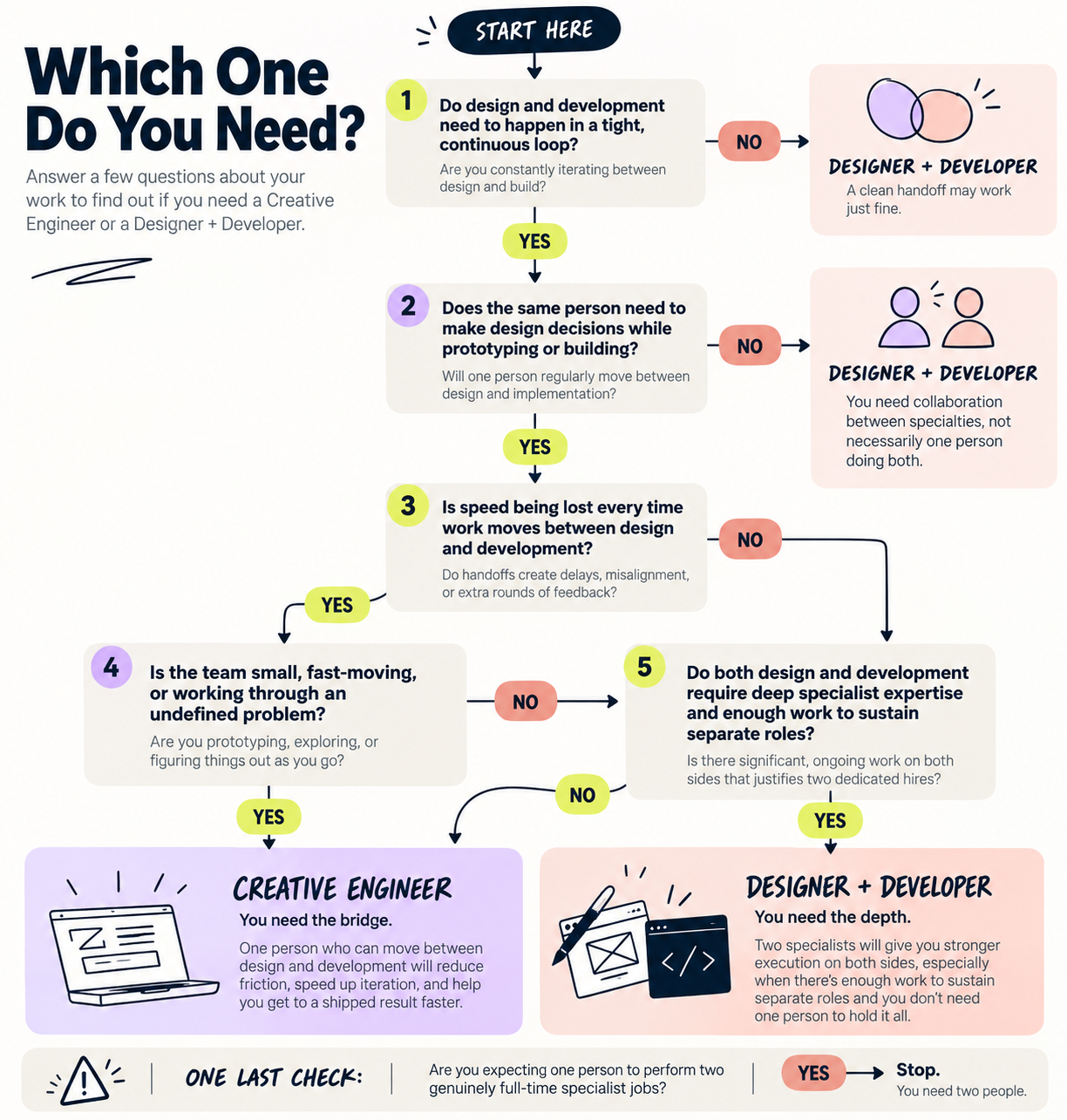
So, Which One Do You Need?
Start with the work, then follow the path.
Do design and development need to happen in a tight, continuous loop?
-
NO → A designer + developer may be the cleaner setup.
-
YES → Keep going.
Will one person regularly need to make design decisions while building or prototyping?
-
NO → You probably have a handoff, not a bridge.
-
YES → Keep going.
Is the team small, fast-moving, or working through an undefined problem?
-
YES → A Creative/Design Engineer may be exactly what you need.
-
NO → Keep going.
Do both design and development require deep, specialized expertise and sustained workloads?
-
YES → Hire the designer + developer.
-
NO → The hybrid may still make more sense.
And one final gut check:
Are you expecting one person to perform two genuinely full-time specialist jobs?
If yes, congratulations. You have diagnosed the problem. You need two people.
Diagnose Before You Post
A Creative Engineer isn’t automatically the more modern or efficient answer to every problem sitting between design and development.
Sometimes one person who can bridge those disciplines eliminates friction, accelerates experimentation, and gets better work out the door faster.
Sometimes two specialists produce better work because both sides genuinely require depth.
Deciding on the title before you've figured out which problem you have is a very expensive mistake.
This is exactly where a talent partner earns their keep. Artisan Talent helps creative companies figure out what their teams actually need before another vague job description hits the internet. Whether the answer is a Creative Engineer, a specialized designer and developer, or flexible talent to fill a very specific gap, we can help you define the role and find the people to do it.
Because finding great talent gets a whole lot easier once you know how many people, and the exact role, you’re actually looking for.