
A creative department at a major national company had a problem, and it wasn’t a missed deadline, a client threatening to walk, or even another round of budget cuts.
It was something perhaps even more ominous: Its freelancers were unhappy, and they were getting ready to leave.
So what? They're freelancers. They were going to leave eventually anyway, right? Not exactly.
These weren't people brought in for a quick logo refresh or a two-week production sprint; they were experienced creatives who had become essential to the department's day-to-day operations. They knew the brand, the workflows, the stakeholders, and exactly which rounds of feedback actually required another round of revisions.
The company relied on them, but the benefits available through their staffing arrangements weren't keeping pace with what those creatives needed.
And eventually, the freelancers decided they'd had enough.
A Lack of Freelancer Benefits Becomes a Retention Problem
The company's creative services department relied heavily on long-term contract talent, for budgetary and operational reasons. Many of these jobs simply wouldn't be able to exist if they weren't freelance. And this team is hardly alone. According to 2026 reporting from Adweek, freelancers and contractors now account for 30% to 70% of the workforce in many Fortune 500 marketing organizations, with companies increasingly relying on external talent for ongoing work rather than one-off projects.
For this particular company, it was a model that worked, as the business maintained staffing flexibility while experienced designers, art directors, and other specialists kept projects moving.
That is, until the benefits became a sticking point.
In a world where we read LinkedIn post after LinkedIn post about bad behavior from companies, this one deserves a lot of credit.
Rather than shrugging off the possibility of losing its talented creative freelancers as the cost of doing business, leadership listened. They invited their staffing partners to present the benefits available to their contractors.
And just like that, the conversation shifted. It wasn't just about who could fill an open role or offer the most competitive hourly rate, but about who could take better care of the talented people already doing the work.
Freelancers had the opportunity to evaluate their options, and many moved toward partners offering stronger benefits.
The result? A happier, more stable creative department with people who could focus on their work rather than what they were missing.
This isn't a reinvented staffing model, but, more effectively, it's simply a story of a company addressing why people were considering leaving.
That's a distinction more hiring managers should pay attention to. As for companies that recognize the value of investing in their freelance talent? Consider this our round of applause! We'd love to see more of it.
Freelancers Want Flexibility (They Also Want to See a Dentist)
There's a persistent assumption that freelancers have willingly traded stability for freedom.
Plenty of experienced creatives prefer contract work. They enjoy choosing projects, working with different brands, and having more control over their careers.
But enjoying flexibility doesn't mean enjoying uncertainty around healthcare, retirement, or paid time off.
Traditional benefits don't follow independent workers as they move between projects and clients. That gap is what the Center for an Urban Future's portable benefits pilot for New York City's freelance creative workforce highlights.
That's particularly relevant to creatives who spend months, sometimes years, embedded within the same organizations.
They're attending the same meetings, working against the same deadlines, and contributing to the same business outcomes as their full-time colleagues, yet the support available to them can look very different.
Of course, not every freelancer wants the same thing. A designer balancing multiple clients may prioritize flexibility and income. A creative professional on a long-term assignment may place greater value on dependable healthcare coverage and paid time away.
The point isn't to assume every freelancer wants a traditional employment arrangement but to stop assuming that choosing freelance work means benefits don't matter.
The Benefits Freelancers Want Most
When hiring managers think about attracting creative talent, compensation usually leads the conversation. And it should. Experienced creatives know what their skills are worth.
But an attractive hourly rate doesn't necessarily make up for a benefits package that leaves someone covering every other expense alone.
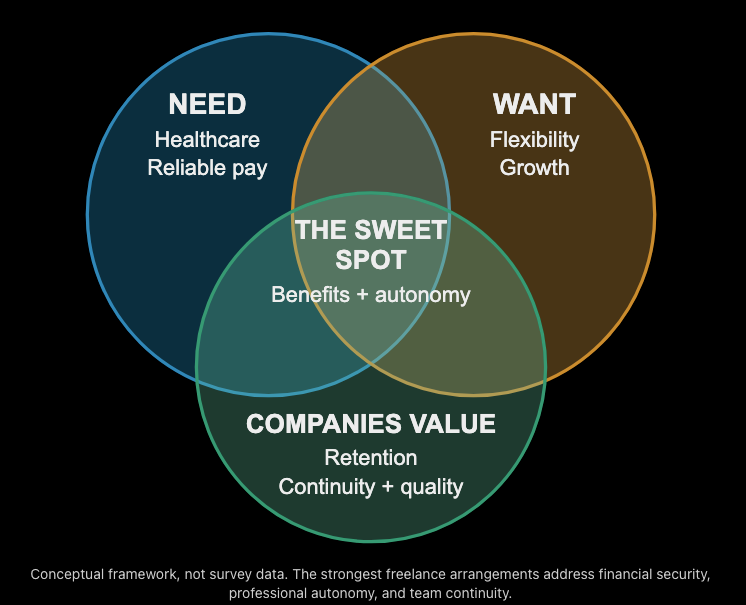
The most meaningful offerings address a few practical priorities:
- Health and wellness: Access to medical, dental, and vision coverage can make a long-term contract considerably more attractive.
- Financial security: Retirement savings options and other financial resources help freelancers plan beyond their current assignment.
- Time away: Paid time off, where available, gives creatives room to recharge without automatically sacrificing income.
- Professional growth: Training, development opportunities, and exposure to interesting projects help keep experienced talent engaged.
- Flexibility and autonomy: Predictable expectations and reasonable control over how work gets done remain important parts of the freelance experience.
These priorities aren't mutually exclusive. The most compelling arrangements combine meaningful financial and health-related support with the autonomy that attracts people to freelance work in the first place.
While companies may not administer these benefits directly, the staffing partners they choose can make a significant difference.
At Artisan Talent, for example, eligible freelancers have access to benefits that can help address some of the financial and healthcare considerations that come with contract work. It's one example of how staffing arrangements can offer more than an hourly rate, giving creatives additional support without sacrificing the flexibility they value.
Replacing a Great Freelancer Costs More Than Just Finding One
Here's where the benefits conversation becomes a business conversation.
When an experienced freelancer leaves, you're not necessarily replacing a single set of technical skills.
You're replacing someone who knows the brand's visual language, understands the approval process, remembers why the team stopped using that particular template, and can distinguish an urgent request from one that just arrived in all caps.
That knowledge has value.
You already know about thje cost of contractor churn, but the problem goes well beyond recruiting another designer or copywriter.
Someone has to review portfolios, conduct interviews, onboard the replacement, explain the brand, and absorb the inevitable slowdown while the new person gets up to speed. Meanwhile, the work hasn't stopped coming in.
This is especially frustrating when the person leaving was otherwise happy with the assignment. So, imagine losing a talented art director who likes the team, understands the work, and wants to stay, simply because another staffing arrangement offers better benefits.
That's a preventable problem. There's an irony here: companies rely on contract talent to stay flexible when permanent hiring isn't practical.
But if that flexibility comes with a revolving door of freelancers, how much time and money are they really saving?
Your Staffing Partner Is Part of Your Retention Strategy
Hiring managers normally don't control the benefits available to freelancers working with staffing firms, but they do have a say in which firms they work with.
And that decision deserves more scrutiny than whether a recruiter can send over three perfect portfolios by Thursday.
A good creative staffing partner understands the assignment, the team's dynamics, and the expertise required to deliver the work.
A great one also understands what makes talented people want to stay.
Choosing the right creative recruiter is about more than filling an immediate opening. It's about building relationships that support the people doing the work and the organizations depending on them.
For hiring managers, that means asking more questions about benefits, ongoing support, and the experience contractors have throughout an assignment.
For working creatives, it means evaluating a staffing partner based on the full opportunity, not just the hourly rate.
The two perspectives meet in the same place: Better-supported talent is easier to retain.
Good Creative Work Needs More Than a Good Rate
Back at that national company's creative department, the solution wasn't another team-building exercise or a speech about how much everyone appreciated the freelancers. It was giving people access to better options.
The company recognized that its creative team could remain flexible without treating long-term freelancers as interchangeable. And its staffing partners became part of the solution.
That's the opportunity for any organization building a creative team around contract talent. You can maintain flexibility, manage headcount, and still make meaningful investments in the people responsible for delivering the work.
It's a philosophy we share at Artisan Talent. Finding the right creative talent matters, but so does creating the conditions that make people want to stick around. Replacing a great freelancer costs more than keeping one, and sometimes, the difference comes down to benefits.

/Creative%20State%20of%20the%20Union%202019.jpg?width=436&height=255&name=Creative%20State%20of%20the%20Union%202019.jpg)