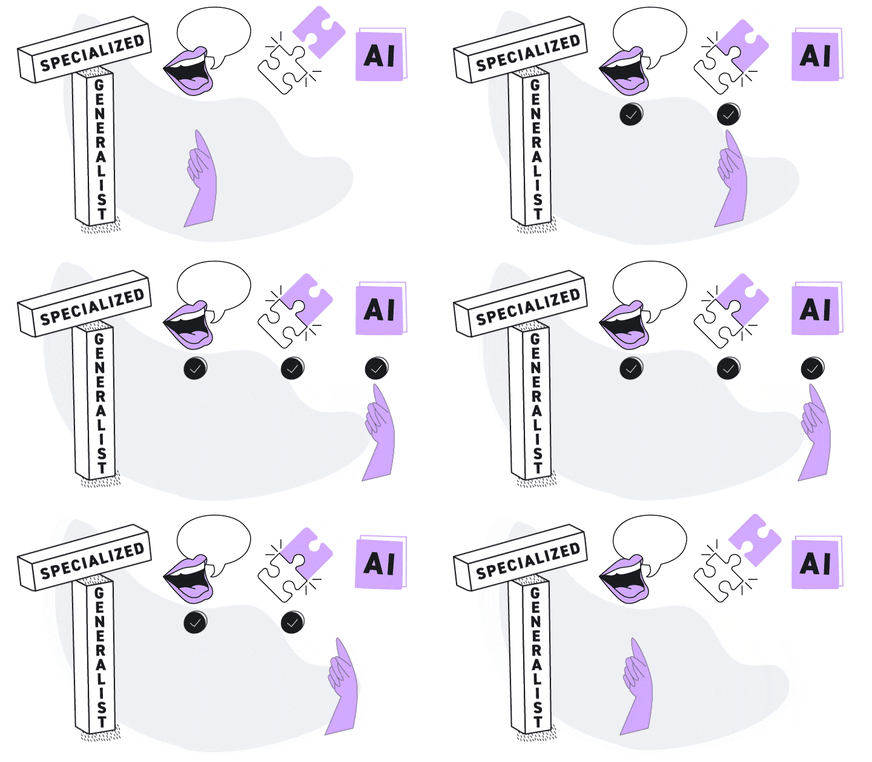
There’s your creative team during a normal week. And then there’s your creative team six weeks before a product launch.
Suddenly, the team who usually handles a reasonable mix of campaigns, content, and production are staring down additional landing pages, paid ads, social assets, emails, sales decks, launch videos, product graphics, and seventeen versions of something that was supposedly “final” yesterday.
TLDR? The team is busy. Slack is starting to look threatening. And someone inevitably asks, “Do we need to hire another person?”
Maybe. But before postioning a full-time role, ask a better question: “What capacity do we actually need, for what work, and for how long?”
Yes, a product launch creates a spike in creative demand, but that doesn’t necessarily mean your company has permanently outgrown its creative team.
A Launch Is a Spike, Not a New Baseline
One of the easiest mistakes to make during a product launch is treating a temporary capacity problem like a permanent headcount problem.
You can see why it happens. If your team normally produces 20 assets a month and suddenly needs 70, the math seems pretty straightforward. More work = more people. Except adding people doesn’t automatically translate into proportional output.
Eleken, a SaaS product design agency, makes exactly this point in its guidance on scaling design teams, stating that scaling a team is not the same as scaling output and to avoid “[scaling] for the sake of scaling. Scale for outcomes.” This distinction matters during a launch.
Bigger teams also introduce more coordination, more handoffs, and more questions about ownership.
Think of it like a snake that just devoured a huge meal. There’s suddenly a lot to digest, and for a while, that snake looks very different than it normally does. But once the meal is digested, it returns to its usual size. A product launch can have the same effect on your creative workload; demand swells dramatically for a stretch, then settles back down once the launch is out in the world.
That’s why the better approach starts by mapping the work before mapping the headcount.
Map the Work Before You Add Headcount
“We need more creative help” is a starting point, not a staffing plan. Where is the actual bottleneck?
Maybe your brand and campaign concepts are covered, but your designers can’t physically produce enough variations for paid social. Maybe design is fine, but one copywriter is suddenly responsible for a landing page, nurture sequence, sales enablement materials, product messaging, and approximately nine million subject lines.
Or perhaps your internal team can handle almost everything, except the launch suddenly requires motion graphics, UX/UI or video capabilities you use twice a year.
Creative operations strategist Cali Zumdahl argues that scaling problems are often less about talent than they are about visibility and allocation. Teams can feel overwhelmed without having a clear picture of existing capacity, available skills, or how talented creatives are being deployed.
That’s an important distinction, so before adding another body to the Zoom grid, figure out where the work is actually getting stuck.
Depending on the launch, you might need to scale:
- Design and asset production
- Copy and content
- Motion and video
- Digital and paid social creative
- Web and landing page production
- Sales enablement and presentations
- Production coordination
- A specialized creative capability
Then determine what your current team can realistically absorb without turning launch month into an endurance sport.
This focus on priorities matters beyond staffing, too. In its guide to product launch strategy, sales enablement platform Spekit points out that without a clear strategic lens, every feature, message, and stakeholder request can begin to feel equally important. The result? Bloat, delays, and diluted impact.
Jon Pipek, founder of go-to-market consultancy Blue Manta Consulting, puts it more succinctly in the guide, stating that “literally nothing matters if the team isn’t aligned.”
For creative leaders, that alignment includes knowing what the core team owns, where additional capacity is needed, and which work can move to someone else without sacrificing the brand.
Don’t Start Hiring When Everyone Is Already on Fire
Contract talent can move quickly. That does not mean your ideal onboarding strategy should be, “Hi! The launch is Tuesday.”
Every outside creative still needs context. They need to understand your brand, audience, campaign strategy, approval process, tools, stakeholders and the particular meaning your organization has assigned to the phrase “quick revision.”
And launch work starts ramping up well before launch day. Spekit’s product launch timeline, for example, places strategy and planning four to six weeks before launch, stakeholder alignment four to five weeks out, content planning three to four weeks out, and actual content creation two to three weeks before launch.
In other words, if you realize you need help when everyone is already producing assets, you’ve probably waited too long.
Creative leaders should work backward from the launch date and identify when workload begins climbing, not simply when the product officially launches. Your additional creative capacity should ideally be onboarded and productive before that climb gets steep.
Otherwise, your busiest employees become responsible for onboarding new people at precisely the moment they have the least time to do it.
TL;DR: Don’t wait until launch month to solve a launch staffing problem.
Sometimes You Don’t Need Another Employee. You Need a Specific Skill for Eight Weeks.
Capacity isn’t always the problem. Capability can be. Product launches have a funny habit of surfacing skills that your company suddenly needs very badly despite barely needing them the other 10 months of the year.
Motion design is a good example. So are video production, UX/UI, presentation design, specialized copywriting, and certain digital platform skills. If you need someone with a particular expertise at full speed for six or eight weeks and only occasionally afterward, that’s not automatically evidence of a hole in your permanent team but instead could be an ideal contract role.
That aligns with the approach outlined by Room4 Teams in its guide to scaling creative production without increasing headcount. Its model separates the work that depends heavily on internal context (strategy, brand ownership, prioritization and final approval) from production-heavy or specialized work that can flex with demand.
Visual Soldiers makes a similar distinction in its guide to scaling design production, noting that sustainable scaling is about more than adding people. Teams also need the systems and processes to increase output without sacrificing quality, consistency or, as they put it, team “health (and sanity!).”
Yes, it’s common sense, but sometimes common sense gets pushed aside in times of stress. So, try to remember that sanity is still a KPI, even if nobody put it in the launch brief.
Think of it like catering Thanksgiving dinner. You might desperately need three extra sets of hands at 2 p.m. on Thursday. That doesn’t mean you need three additional adults permanently living in your kitchen.
The need is real. The duration matters.
Build a Launch Pod, Not an Army
Instead of asking how many people you need to hire, think about building a temporary launch pod around your existing creative team.
Your internal team keeps the things it knows best: strategy, institutional knowledge, creative direction, and brand ownership.
Then flexible talent fills the launch-specific gaps. Maybe that means a motion designer and production designer working alongside your existing art director. Maybe it’s a senior copywriter taking campaign production off your content lead’s plate. Maybe it’s a presentation designer handling sales enablement while your internal designers focus on customer-facing launch assets.
The exact combination matters less than the principle of matching the shape of your staffing to the shape of the work. But flexible staffing only works when ownership remains clear.
That lesson comes up repeatedly in guidance on scaling creative teams. Eleken warns that “if everyone kind of owns UX, nobody owns UX,” while Zumdahl emphasizes systems that give teams clearer visibility into capacity, people, and responsibilities.
So, decide who owns strategy. Who owns final creative approval? Which specialist owns which deliverable? Who handles feedback? And who has the final say when five stakeholders provide five mutually exclusive definitions of “make it pop”?
Answer those questions before production ramps up. The same goes for your processes. Brand guidelines, messaging frameworks, templates, briefs, and approval workflows aren't the sexiest part of a product launch, but they make it much easier for an outside creative to enter the team without requiring a three-week archaeological dig through your Google Drive.
Zumdahl describes this as creating systems that reduce the need to repeatedly make the same decisions. Room4 Teams similarly recommends systemizing briefs, templates, and brand rules so additional production capacity can execute consistently without constant supervision.
The easier your creative operation is to enter, the easier it becomes to scale.
Your Team Doesn’t Need to Stay Launch-Sized Forever
There’s a reason product launches put creative staffing models under a microscope. They require companies to produce unusually high volumes of unusually important work on unusually unforgiving timelines.
But the goal isn’t to build a team that can operate at launch intensity indefinitely.
It’s to build the right team for the moment, and that might mean:
- adding permanent headcount when the workload truly represents sustained growth;
- bringing in a specialist for two months; or
- adding several contract creatives around a strong internal core and scaling that extra capacity back once the launch is complete.
The takeaway? You’ve done the heavy lifting by identifying the need and arriving at the point of needing more help, so the hardest part shouldn’t be finding those people who are best suited to do the work. Your product launch already has enough moving pieces, and finding someone who knows how to make the pieces shouldn’t be another one.
That’s where Artisan Talent can help. Instead of starting a new search every time your workload spikes or a launch plan reveals a missing skill, you can tap into experienced creative, digital, and marketing talent matched to the work in front of you.
Planning a launch and already seeing the gaps? Reach out to Artisan Talent to start building the creative team you’ll need to get it across the finish line.